Gold Country Field Journal
7-30 Waters Field Journal, Issue No. 1: What the Evidence Actually Shows
Issue No. 1 establishes the 7-30 Waters Field Journal's evidence method. It separates the sourced historical record, a provisional 120-grain velocity observation, a separately identified 139-grain target, reader reports and untested hypotheses, then gives readers a reusable field-record protocol for the next matched comparison.
Issue No. 1 asks a foundational question: what do we actually know from sources and retained observations—and what must still be tested—about the 7-30 Waters as a working rifle system?
Editor’s note: this issue is about evidence, not a winner
The 7-30 Waters attracts confident claims about efficiency, trajectory, recoil, accuracy, expansion and penetration. Some begin with sound principles. Few remain useful unless the rifle, ammunition, conditions and evidence are disclosed.
This first Field Journal issue establishes the publication method. It separates four things that are often blended together:
- Established source record: information supported by an identified publication or manufacturer.
- GCA observation: something Gold Country Ammunition recorded under partially or fully stated conditions.
- Client or reader report: useful submitted experience that has not become a controlled GCA test.
- Working hypothesis: an idea that can guide the next test but is not yet a conclusion.
Issue finding: the retained record is enough to define better questions and a repeatable test, but not enough to declare a universal 120- or 139-grain field winner.
What is established from sources
Wolfe Publishing’s Handloader retrospective reports that Ken Waters began planning the cartridge in 1976, used a Marlin Model 336-A for the first project rifle in 1977, and worked from the .30-30 Winchester case with a .284-inch bullet. It describes the objective as higher velocity, flatter trajectory and lower recoil than the standard .30-30 while retaining useful deer-rifle performance. U.S. Repeating Arms Company/Winchester and Federal Cartridge commercialized the design in 1984.
The cartridge has appeared in tubular-magazine lever rifles and single-shot firearms. Those platforms must not be treated as interchangeable. The firearm maker’s instructions and current pressure-tested component data control ammunition and loading decisions; a general cartridge history does not.
| Established point | Source role | Boundary |
|---|---|---|
| Ken Waters developed the cartridge from the .30-30 case around a .284-inch bullet. | Handloader/Wolfe historical retrospective. | A retrospective is not a current loading manual. |
| The design was commercialized in 1984 by U.S. Repeating Arms Company/Winchester and Federal Cartridge. | Handloader/Wolfe historical retrospective. | Historical production does not establish current availability. |
| Model 94 operation and ammunition handling require manufacturer instructions matching the rifle generation. | Winchester manual library. | A general Model 94 manual does not supply a 7-30 Waters recipe. |
| Current handloading decisions require pressure-tested data for the exact supported component combination. | Hodgdon Reloading Data Center and component-maker instructions. | Chronograph velocity and case appearance do not substitute for pressure data. |
What GCA has directly retained
Observation A: the 120-grain velocity record
Repository notes preserve a reported 2,563-fps observation for a 120-grain load fired from a 24-inch Winchester 94 AE with iron sights. That is a bounded observation—not a published load recommendation and not a 120-versus-139 comparison.
The original chronograph model, placement, date, weather, ammunition lot, shot count and complete string have not yet been attached to this publication record. Until they are, the number should be treated as provisional context rather than a benchmark.
Observation B: the 139-grain target
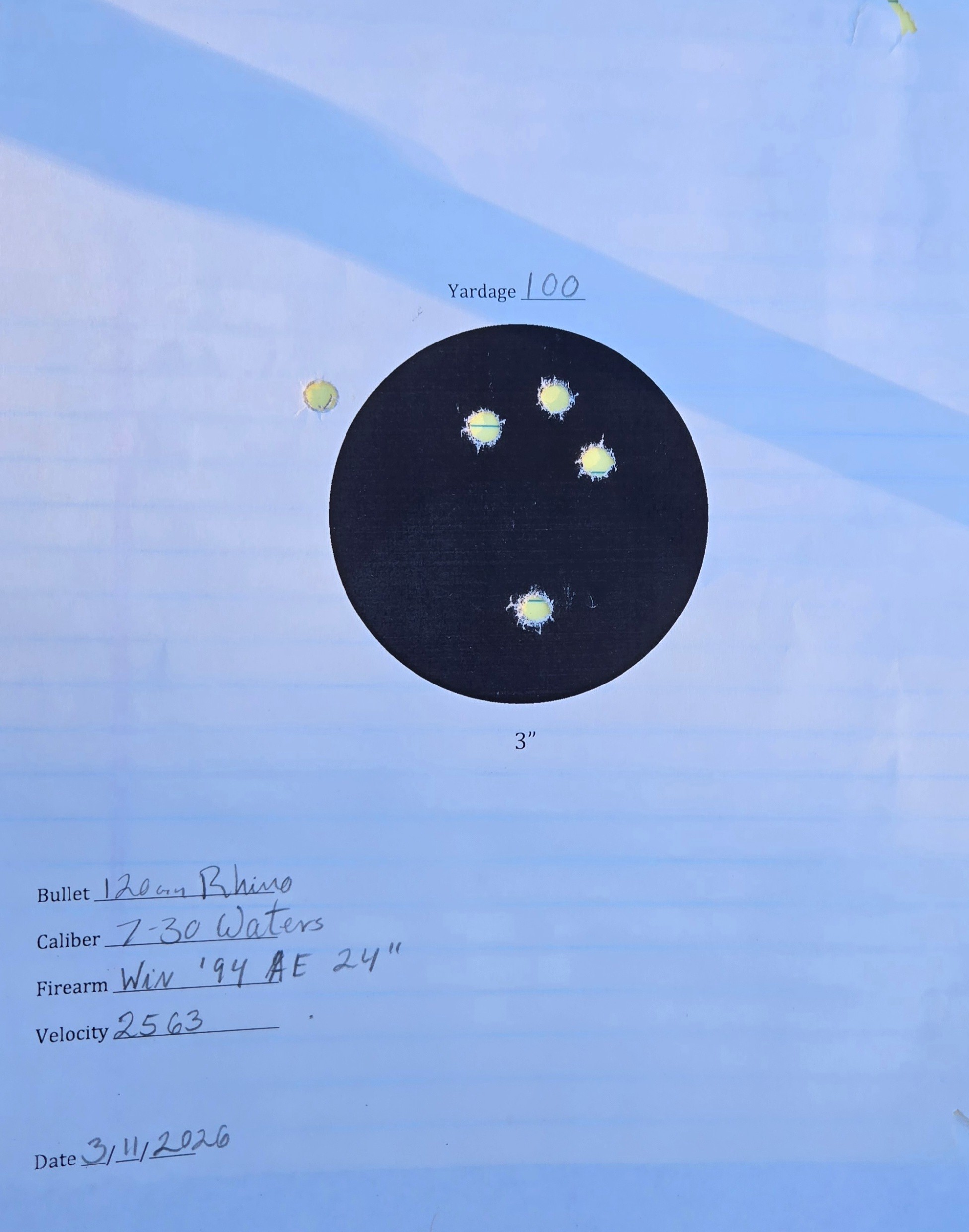
The photograph establishes that a target exists and that Kevin identifies it with 139-grain work. It does not, by itself, establish the ammunition recipe, group size, statistical repeatability, terminal performance or superiority over the 120-grain option.
What these observations do not establish
- That the two observations came from a matched test.
- That either weight is universally more accurate.
- That the 120-grain option always produces less recoil or a flatter useful trajectory.
- That the 139-grain option penetrates farther, retains more energy at impact or tolerates poorer shot angles.
- That flat-nose geometry alone predicts expansion or terminal behavior.
- That a chronograph reading establishes chamber pressure.
- That representative tools named on an earlier version of this page were used in one controlled session.
The detailed 120-versus-139 evidence comparison maintains the current weight-by-weight record and matched-test requirements.
The working questions
The current evidence supports questions, not predetermined answers:
- How do the two exact GCA bullets differ in dimensions and construction?
- How does each supported ammunition configuration function through the same rifle and magazine?
- What velocity variation appears across complete, retained strings under the same conditions?
- What accuracy does the same rifle produce across repeated groups with the same sighting system?
- If terminal testing is performed, what happens at measured impact velocities in a defined and repeatable medium?
- Which differences persist when rifle, distance, ammunition lot and procedure are controlled?
The next field protocol
| Stage | Required record | Why it matters |
|---|---|---|
| Identity | Firearm make/model, chamber marking, barrel length, sights, magazine system and private serial reference. | Prevents results from floating free of the rifle that produced them. |
| Ammunition | Exact SKU or component identities, authoritative data source, lot/batch and assembly record. | Separates a reproducible product or test lot from a generic weight class. |
| Conditions | Date, location class, temperature, weather and elevation when relevant. | Makes later comparisons interpretable. |
| Velocity | Chronograph model, placement, complete string, exclusions, average, ES and SD with sample size. | Preserves the underlying observations rather than only the summary. |
| Target | Distance, target ID, aiming method, shot count, called shots, all impacts and calibrated measurement. | Allows readers to inspect how an accuracy statement was produced. |
| Function | Magazine loading, feeding, chambering, firing, extraction and ejection for every round. | Keeps function separate from accuracy and terminal claims. |
| Terminal work | Defined medium, measured impact velocity, repeated shots, recovery method, photographs and limitations. | Prevents construction intent from being reported as observed performance. |
| Review | Unanswered questions, reviewer, review date and links to retained originals. | Keeps the public derivative traceable. |
Printable field record
Print or save this section before a range session. Do not fill missing information from memory after results are known.
| Date / location class | ________________________________ |
|---|---|
| Weather / temperature | ________________________________ |
| Firearm / chamber / barrel | ________________________________ |
| Sights or optic | ________________________________ |
| Ammunition SKU or test-lot ID | ________________________________ |
| Bullet / case / primer identifiers | ________________________________ |
| Authoritative data source | ________________________________ |
| Chronograph / placement | ________________________________ |
| Complete velocity string | ________________________________ |
| Target distance / target ID | ________________________________ |
| Shot count / called shots | ________________________________ |
| Function observations | ________________________________ |
| Photo filenames | ________________________________ |
| Limitations / next question | ________________________________ |
Safety boundary: This journal publishes no improvised load recipe. Use current pressure-tested data applicable to the exact components and firearm. Velocity, primer appearance and case appearance do not establish safe pressure. If the supported data does not cover the intended combination, stop and consult the component manufacturer or a qualified ballistic laboratory.
Reader observations: useful, but not automatically evidence
Reader and client reports can identify patterns and future tests. They enter the journal as attributed or anonymous observations only after permission and metadata review. GCA does not convert an unpublished recipe, chronograph summary or subjective result into pressure-tested load data.
A useful submission includes the firearm and barrel, exact bullet and ammunition identity, complete shot count or velocity string, chronograph information, conditions, target distance, unedited photographs and permission preferences. Submissions with missing information may remain internal leads.
Maker inclusion: GCA as the disclosed control case
Gold Country Ammunition makes or sells the 120- and 139-grain products connected to this work. They are included because they provide exact, maintainable product identities for the pilot publication system—not because inclusion purchases a favorable conclusion.
- 120-grain loaded ammunition record.
- 139-grain loaded ammunition record.
- 120-grain component-bullet record.
- 139-grain component-bullet record.
The live product pages remain the authority for current specifications, quantity, price, stock and fulfillment. Future outside makers may be included only under the same disclosure and evidence rules.
Issue conclusions
- The historical development and commercialization record is strong enough for a concise sourced account.
- The 120-grain velocity observation and 139-grain target are distinct records and must remain separate.
- Neither record supports a universal performance winner.
- The next valuable work is recovering original metadata and conducting a matched, retained comparison.
- The journal’s authority will come from showing its limits as clearly as its findings.
Sources and continuing paths
- Handloader: “Bullets & Brass — 7-30 Waters”.
- Winchester Model 94 owner’s manuals.
- Hodgdon Reloading Data Center.
- The 7-30 Waters Cartridge Guide.
- Lever-action bullet-selection guide.
- 120-versus-139 evidence comparison.
Issue reviewed: October 2, 2026. Update this issue when original observation records or a matched test become available; preserve the prior findings and change note.
Disclosure: Gold Country Ammunition publishes this journal and makes or sells the GCA products included as the initial maker-control case. Inclusion does not establish accuracy, safety, terminal performance or superiority.
Continue the path
Go deeper without losing the thread
These reviewed references continue the same question through platform context, technical detail, field evidence and available products.