RELOADER’S DEN · .308 WINCHESTER RELOADING
Equipment, components and guidance for reloading .308 Winchester cartridges
We built this room to answer: What equipment and components do I need to reload .308 Winchester cartridges?
The room connects the press, .308 Winchester dies, case-preparation tools, measurement equipment, brass, jacketed-bullet choices, published loading references, maintained load data and chronograph work in one deliberate sequence.
The .308-inch bullet diameter is shared by many cartridges, but diameter alone does not establish that a bullet, load or finished cartridge suits a particular .308 Winchester rifle. Construction, weight, seating requirements, magazine limits, intended work and current data remain part of the same decision.
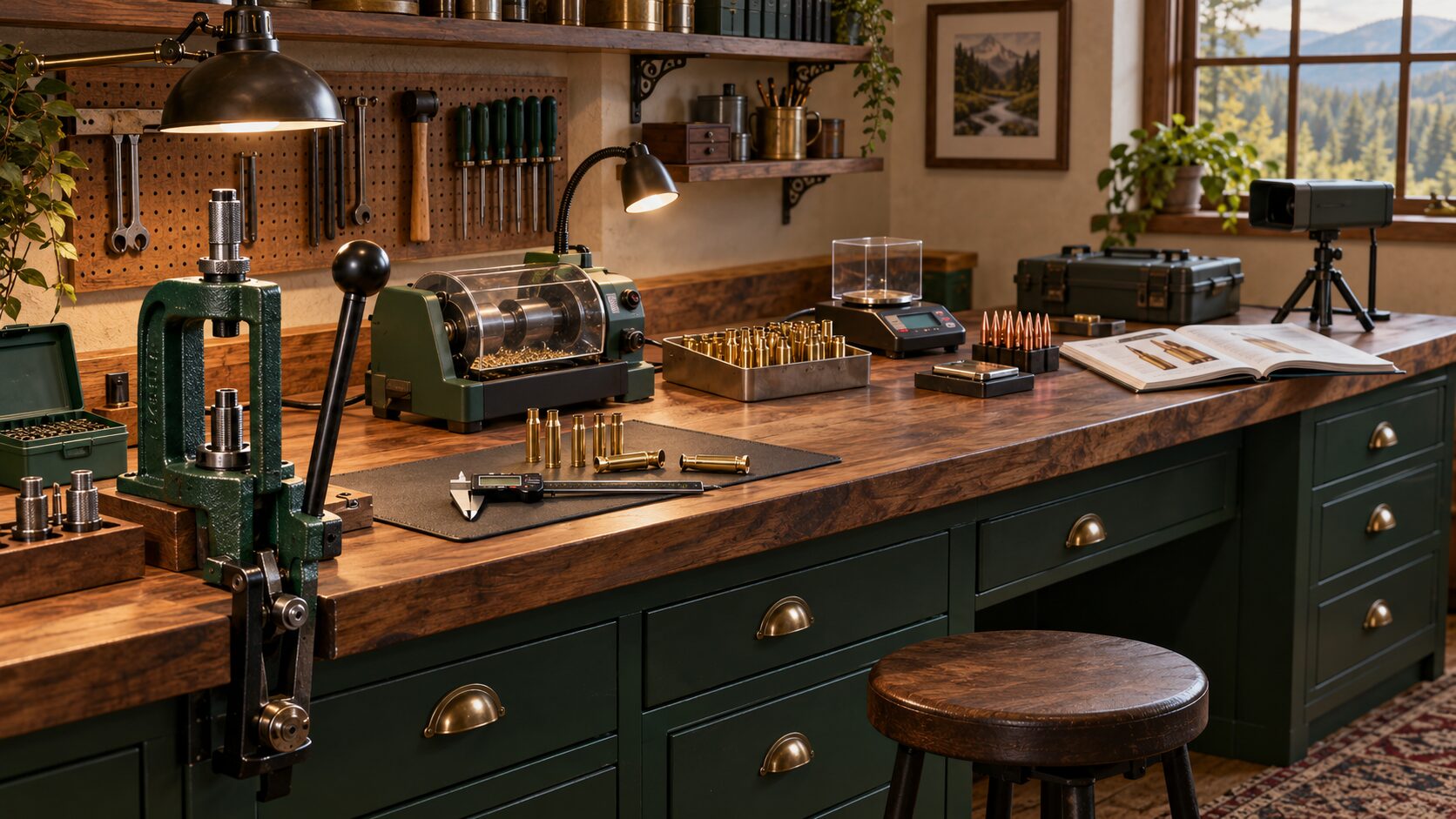
AI-assisted application visualization. Products are shown in a representative working environment to explain their roles. Follow each product link for the exact item, current specifications and availability. Product proximity does not constitute load data or establish component compatibility.
The working system
What do you need to reload .308 Winchester cartridges?
1. Single-stage reloading press
The Hornady single-stage press supplies controlled mechanical movement for sizing and seating. The .308 Winchester dies and their instructions control the cartridge-specific operations.
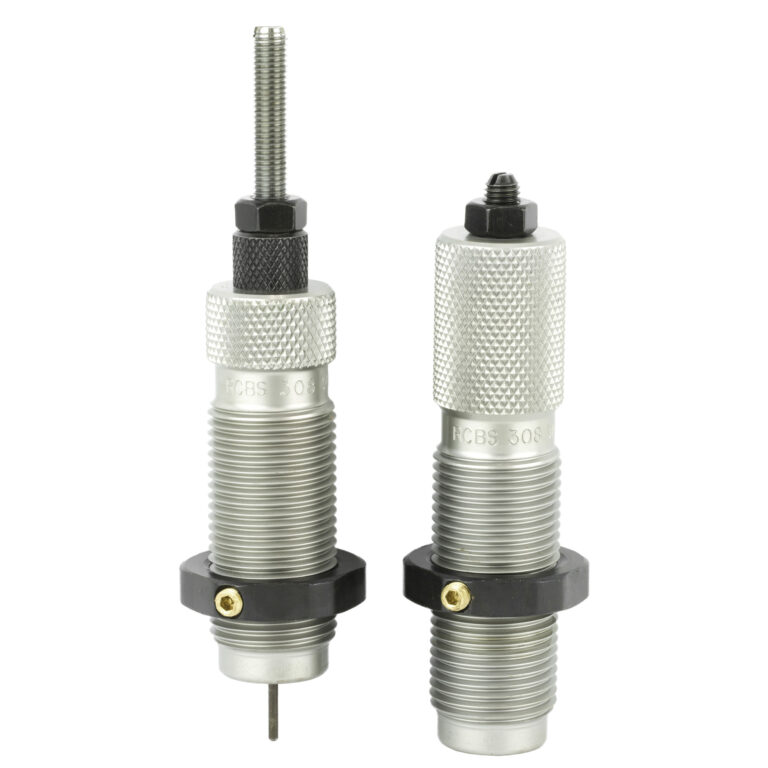
2. .308 Winchester reloading dies
The RCBS 15501 full-length .308 Winchester die set supplies the cartridge-specific sizing and seating functions. Confirm shellholder, die adjustment, seating and crimp requirements from the exact instructions and the needs of the rifle being loaded.
3. .308 Winchester case preparation
Inspect, clean and measure each case before deciding what preparation is required. Trim, chamfer and deburr only where case condition and current specifications call for it.
4. Measuring .308 Winchester cases and cartridges
The digital caliper checks the dimensions named by the die instructions, current data and actual rifle. Measurement supports the decision; it does not make the decision.
5. Measuring powder charges
The electronic scale verifies the charge selected from current .308 Winchester data. Powder, primer and charge decisions remain controlled by the cited source.
6. New .308 Winchester brass
Use verified .308 Winchester brass as the cartridge foundation. Confirm headstamp, condition and case identity before preparation and sizing.
7. Choosing a bullet weight for .308 Winchester
Choose weight and construction for the rifle, twist, magazine, intended distance and actual job. The 135-through-220-grain paths answer different questions rather than forming a simple light-to-heavy ranking.
8. Published .308 Winchester loading reference
Use the Hornady Reloading Manual only for the .308 Winchester data and components it actually lists. Confirm the exact bullet and test context before assembly.
9. Load data for .308 Winchester bullets
Search the maintained library by bullet weight, type, manufacturer and published source, then use the complete series that matches the component being considered.
10. Chronographing a .308 Winchester load
Record velocity in the actual rifle and conditions tested. Treat it as one part of the load record, not independent proof of pressure, accuracy or terminal performance.
Bullet decisions
Continue by job—not grain weight alone.
The first anchor is our 135-grain .308 Scorpion open-tip flat-base bullet. Its controlled-expansion, deep-penetration design and repeat customer demand helped open the broader .308 investigation. A .308-inch diameter still does not establish suitability for every cartridge, rifle or magazine.
Load data
Load data for .308 Winchester bullets
Use the maintained library to find complete, source-attributed .308 Winchester series by bullet weight, bullet type, manufacturer and published source. Select the complete series matching the component and application being considered.
Showing 10 of 226 complete load series.
150 gr — Barnes X
Named-bullet data · rifle
Source: Lee Precision Reloading Data · Powder: Alliant RL-15
| Charge | Velocity | COAL | Pressure | Published remarks |
|---|---|---|---|---|
| 36.3 gr | 2348 fps | 2.600" | starting load; minimum COAL: 2.600 inches | |
| 45.0 gr | 2815 fps | 2.600" | 56800 PSI | max load; minimum COAL: 2.600 inches; 56800 psi |
165 gr — Barnes X
Named-bullet data · rifle
Source: Lee Precision Reloading Data · Powder: IMR IMR-4064
| Charge | Velocity | COAL | Pressure | Published remarks |
|---|---|---|---|---|
| 40.0 gr | 2455 fps | 2.800" | starting load; minimum COAL: 2.800 inches | |
| 42.5 gr | 2600 fps | 2.800" | 58000 PSI | max load; minimum COAL: 2.800 inches; 58000 psi |
168 gr — Barnes TTSX BT
Named-bullet data · rifle
Source: Hodgdon Rifle Data · Powder: Hodgdon Benchmark
| Charge | Velocity | COAL | Pressure | Published remarks |
|---|---|---|---|---|
| 38.0 gr | 2458 fps | 2.800" | 44,500 PSI | start load; COL: 2.800"; 44,500 psi |
| 42.0 gr | 2686 fps | 2.800" | 59,500 PSI | max load; compressed; COL: 2.800"; 59,500 psi |
175 gr — Jacketed Bullet
Named-bullet data · rifle
Source: Lee Precision Reloading Data · Powder: Accurate AAC-2230
| Charge | Velocity | COAL | Pressure | Published remarks |
|---|---|---|---|---|
| 36.0 gr | 2319 fps | 2.800" | starting load; minimum COAL: 2.800 inches | |
| 40.0 gr | 2551 fps | 2.800" | 60000 PSI | max load; minimum COAL: 2.800 inches; 60000 psi |
180 gr — Barnes X
Named-bullet data · rifle
Source: Lee Precision Reloading Data · Powder: Vihtavuori VV-N540
| Charge | Velocity | COAL | Pressure | Published remarks |
|---|---|---|---|---|
| 34.7 gr | 2098 fps | 2.795" | starting load; minimum COAL: 2.795 inches | |
| 39.5 gr | 2353 fps | 2.795" | max load; minimum COAL: 2.795 inches |
200 gr — Jacketed Bullet
Named-bullet data · rifle
Source: Lee Precision Reloading Data · Powder: Winchester W-748
| Charge | Velocity | COAL | Pressure | Published remarks |
|---|---|---|---|---|
| 39.4 gr | 2256 fps | 2.530" | starting load; minimum COAL: 2.530 inches | |
| 43.0 gr | 2435 fps | 2.530" | 50000 CUP | max load; minimum COAL: 2.530 inches; 50000 cup |
220 gr — Jacketed Bullet
Named-bullet data · rifle
Source: Lee Precision Reloading Data · Powder: Accurate AAC-2230
| Charge | Velocity | COAL | Pressure | Published remarks |
|---|---|---|---|---|
| 32.4 gr | 1945 fps | 2.800" | starting load; minimum COAL: 2.800 inches | |
| 36.0 gr | 2140 fps | 2.800" | 45300 CUP | max load; minimum COAL: 2.800 inches; 45300 cup |
150 gr — Jacketed Bullet
Named-bullet data · rifle
Source: Lee Precision Reloading Data · Powder: Vectan TU5000
| Charge | Velocity | COAL | Pressure | Published remarks |
|---|---|---|---|---|
| 45.1 gr | 2608 fps | 2.600" | 37010 CIP | starting load; minimum COAL: 2.600 inches; 37010 cip |
| 45.1 gr | 2608 fps | 2.600" | max load; minimum COAL: 2.600 inches |
165 gr — Barnes X
Named-bullet data · rifle
Source: Lee Precision Reloading Data · Powder: Alliant RL-15
| Charge | Velocity | COAL | Pressure | Published remarks |
|---|---|---|---|---|
| 34.9 gr | 2211 fps | 2.750" | starting load; minimum COAL: 2.750 inches | |
| 43.5 gr | 2675 fps | 2.750" | 57000 PSI | max load; minimum COAL: 2.750 inches; 57000 psi |
168 gr — Hornady A-Max or BTHP
Named-bullet data · rifle
Source: Brian Pearce, Wolfe Publishing Company · Powder: Accurate AAC-2495
Restrictions: exact bullet context
| Charge | Velocity | COAL | Pressure | Published remarks |
|---|---|---|---|---|
| 34.9 gr | 2163 fps | 2.800" | ||
| 36.5 gr | 2243 fps | 2.800" | ||
| 38.1 gr | 2361 fps | 2.800" | ||
| 39.8 gr | 2455 fps | 2.800" | ||
| 41.4 gr | 2541 fps | 2.800" | maximum load |
The method
Reload .308 Winchester in working order
- Identify the rifle, chamber, magazine, barrel and intended job.
- Inspect and identify the brass.
- Size and prepare according to current instructions.
- Measure the required case and cartridge dimensions.
- Choose bullet construction and weight for that rifle and application.
- Consult current data for the exact bullet class and weight.
- Assemble deliberately and preserve the complete record.
- Evaluate only what the actual rifle and session demonstrate.