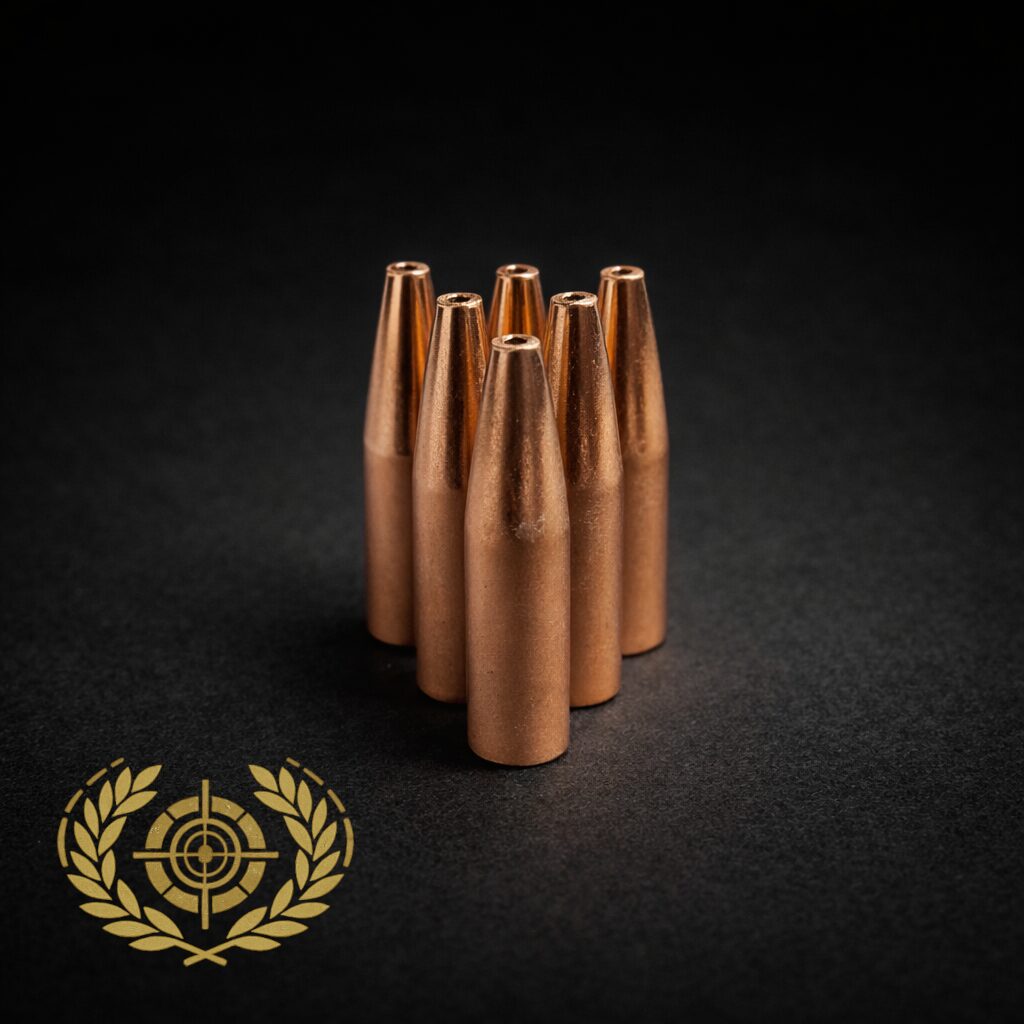
A repeat customer recently placed his fifth order for our 135-grain .308 Scorpion, this time for five boxes—500 bullets. He uses it in reduced-load, 200-yard CMP marksmanship competition with an iron-sighted M1903A3 Springfield chambered in .30-06. That does not prove a national shortage or a mass market. It does answer the question more concretely than speculation could: at least one serious competitor needs this weight because it delivers the consistency he has not obtained from the nearby bullets he tried in that rifle.
The short answer is that 135 grains occupies a lighter part of the .308-diameter range where a shooter may balance velocity, recoil, cartridge capacity and terminal behavior differently than someone choosing a conventional 150-, 165- or 180-grain bullet. But the number stamped on the box is only the beginning. A 135-grain bullet made for rapid varmint expansion, a tipped lever-gun design and an open-tip bullet made for controlled expansion and deep penetration are not interchangeable simply because they weigh the same.
Three bullets can share a weight without sharing a job
Sierra’s current 135-grain HP Varminter #2124 is a .308-inch hollow-point design. Sierra publishes data using that bullet for cartridges including .300 AAC Blackout, .300 HAM’R and .308 Winchester, and describes a short-range medium-game and varmint role in its .300 Blackout material. Those are Sierra’s applications for Sierra’s bullet.
Hornady’s 135-grain FTX #3027 is a different answer. Hornady identifies it as a tipped .308-inch bullet and describes the FTX construction around its flexible tip, InterLock ring, secant ogive and controlled-expansion jacket. Hornady also places the FTX family in the lever-gun and tubular-magazine world. That construction and geometry cannot be assumed from weight alone.
Our 135-grain .308 Scorpion is different again. We build this version with an open tip, a flat base and our 6S ogive. The design intent is controlled expansion with deep penetration: retain mass, continue through tissue toward vital organs and expend energy along the penetration path instead of depending on a rapid or explosive shallow wound channel. We formerly sold this same bullet under the Coyote name; Scorpion is the maintained name.
Where 135 grains earns its place
We have found this weight useful across a broad range of .308-diameter rifles. It works especially well in the .300 HAM’R and .300 AAC Blackout, and it gives the .308 Winchester, .30-06 Springfield and other higher-powered .30-caliber rifles a lighter-recoiling option for enjoyable shooting, training and varmint work. That breadth is one of the best reasons for keeping the design available: it is light enough to change how a familiar rifle feels without reducing the bullet to a single-cartridge specialty.
That is a description of what we designed the bullet to do and where we have found it useful. It is not a promise that every cartridge, firearm, velocity or target will produce the same result. We will add measured velocity windows, recovered-bullet records and controlled field evidence as we establish them.
A discontinued match bullet left a real opening
The customer did not choose 135 grains merely because it was light. He had used the discontinued Sierra 135-grain MatchKing and needed a replacement for CMP competition. He reports that a 125-grain TNT and Sierra’s current 135-grain Varminter did not give him the same consistency in his M1903A3, while a 125-grain bullet does shoot well in his M1917.
That comparison contains two lessons. First, a discontinued bullet can leave a small but important group of shooters without a true functional replacement even when other bullets of similar weight remain available. Second, the rifle is part of the system. A bullet that disappoints in one rifle may perform very well in another, and a shared diameter or nearby weight does not erase differences in construction, geometry or barrel response.
The same customer has now returned five times. He considers the bullet expensive, but considers match fees and the other costs of competition too high to risk on a bullet that will not hold the consistency he needs. That is not a universal accuracy claim. It is documented repeat use by a shooter solving a specific problem.
What a handloader must compare
Before treating two 135-grain bullets as substitutes, compare more than diameter and weight:
- nose shape and tip or opening geometry;
- flat base, conventional boat tail or rebated boat tail;
- jacket and core construction;
- bullet length and bearing surface;
- seating depth, magazine space and firearm function;
- published data for the exact cartridge and bullet;
- the velocity range and target the bullet is expected to encounter.
Those differences can change usable case space, pressure behavior, feeding and terminal behavior. An equal-weight substitution still requires a return to reliable published data and a careful load-development process. We do not publish a load recipe here because the point is selection, not a universal formula.
Current-production note: Our current Scorpion production uses a 1.000-inch jacket before nose forming; earlier production used a 0.925-inch jacket. We retain the same flat base, 6S ogive, finished weight and hand-swaging process, but returning handloaders should still measure a new lot, verify base-to-ogive and cartridge dimensions, and confirm seating and function before loading a full quantity. We have asked this competitor to report whether the current production maintains or improves the performance he established with the earlier version.
Are 135-grain .308 bullets hard to find?
The evidence does not support that broad claim. In our dated distributor review, Chattanooga listed Hornady and Sierra 135-grain component bullets while RSR did not show a detected 135-grain .308 component row in the comparison set. That proves the shelves were uneven on that date—not that the entire weight was unavailable.
What is harder to find is a clear explanation of why the available designs differ and what a shooter must verify before choosing one. That is the gap we can responsibly fill.
Where our Scorpion fits
Choose our 135-grain Scorpion when the open-tip, flat-base, 6S-ogive construction and its controlled-expansion, deep-penetration design intent match the work you are trying to do. It can also make a familiar .308 Winchester, .30-06 Springfield or similar .30-caliber rifle more comfortable and enjoyable for practice, training and varmint shooting while preserving the precision of a hand-swaged bullet.
The bullet is broadly useful in .308-diameter rifles, but the loading arrangement is not universal. A .300 AAC Blackout, .300 HAM’R, .308 Winchester and .30-06 Springfield do not use interchangeable load data. Cartridge dimensions, bullet length, construction, seating, firearm function and data for the actual combination still matter.
A record we can keep improving
We are building a maintained .308-diameter guide that will place this bullet beside the other major weight classes and explain what changes as weight, shape and construction change. We are also beginning a continuity record for shooters trying to replace a discontinued or intermittently stocked design without pretending that every nearby weight is an exact substitute.
If you have documented experience with a 135-grain .308 bullet, tell us the cartridge, rifle, intended use and what you can substantiate. Chronograph records, group records, recovered bullets, dated packaging and original loading notes are especially useful. We review submissions before they become part of the maintained record.
Sources and evidence boundaries
- Sierra Bullets catalog and Sierra cartridge data for #2124
- Hornady 135-grain FTX #3027
- Gold Country Ammunition product specifications and production experience
- RSR and Chattanooga distributor observations recorded October 4, 2026